

Contact us
Connect with our expert today.

Canada is consulting on new 2027 Express Entry pathways, with US H-1B holders, researchers, AI/tech professionals and Global Talent Stream workers among the proposed priority groups.
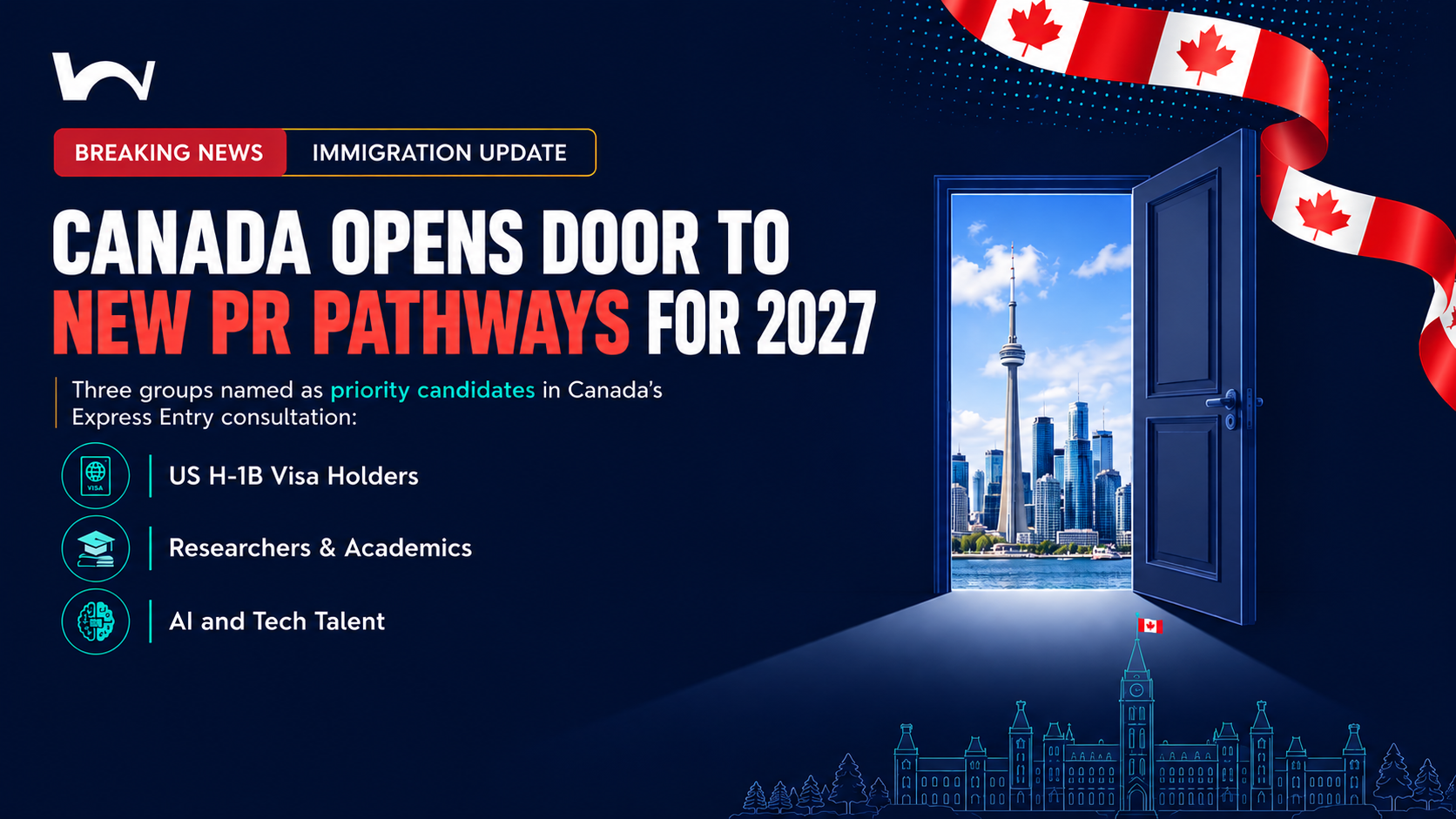
Canada has launched public consultations on new Express Entry pathways for permanent residence starting 2027 with US H-1B visa holders, researchers, and AI professionals named as priority groups. Here's what's actually being proposed, who it affects, and what aspirants should do while the rules are still being written.
Canada has taken the first formal step toward creating new permanent residence pathways for 2027, publishing a public consultation survey — open from August 4 to September 1, 2026 — that names four groups as priority candidates for fast-tracked PR selection: US H-1B visa holders, researchers, AI and tech professionals under the Global Talent Stream, and applicants tied to a new international talent strategy. The move signals where Express Entry's category-based selection (CBS) system is headed for 2027, when Canada plans to admit 122,000 permanent residents through Express Entry alone.
Category-based selection is the mechanism Canada uses to invite specific groups of skilled workers like healthcare professionals or tech workers ahead of the general applicant pool, based on current economic priorities.
Under regular Express Entry draws, candidates are ranked purely by their Comprehensive Ranking System (CRS) score. CBS works differently: it lets Immigration, Refugees and Citizenship Canada (IRCC) invite top-ranked candidates within a defined category — say, French-language proficiency, or trades workers — even if their overall CRS score is lower than candidates outside that category.
In 2026 so far, IRCC has run 18 category-based draws, inviting a combined 58,216 candidates. Not every category has seen equal use — Trades, Transport, and Skilled Military Recruits have each been drawn only once this year, while the STEM category hasn't been used at all since 2024. This uneven usage is part of why IRCC is now asking the public whether the current list of categories should be narrowed for 2027, rather than kept as broad as it is today.
IRCC's 2027 survey centers on four specific groups being considered for new or expanded PR pathways: US H-1B visa holders, researchers, applicants connected to the International Talent Attraction Strategy, and workers under the Global Talent Stream and it's asking Canadians directly how much priority each should get.
IRCC is openly asking the public whether it should shrink the number of CBS categories for 2027 and concentrate invitations on a smaller, more targeted set of occupations — rather than continuing to draw across all sectors facing shortages.
This is a genuine open question in the consultation, not a confirmed decision. The survey presents two options directly to respondents: keep selecting skilled workers broadly across occupations facing shortages, or narrow the focus to fewer, more targeted occupations. Given that two of the ten existing categories have barely been used in 2026, a narrower, more deliberately prioritized system in 2027 looks like a realistic outcome — but the specific categories that would be kept, merged, or dropped haven't been decided.
Yes — separately from the CBS survey, IRCC has proposed replacing all three existing Express Entry programs with a single streamlined program, and re-weighting the points system to favour higher-earning occupations.
This is arguably the bigger story for aspirants to watch. Proposed in April 2026, with public consultations concluding in May, the reform would restructure the Comprehensive Ranking System (CRS) to award tiered bonus points based on wage level — roughly, extra points for occupations paying at least 2x, 1.5x, and 1.3x the national median wage. IRCC has given itself a 12–18 month window to roll out the full reform, but officials have indicated that some elements, including the high-wage occupation factor, could land sooner than the rest.
For candidates, the practical implication is straightforward: if this goes ahead as proposed, higher-paying job offers and occupations will carry more weight in your CRS score than they do today, on top of the usual language, education, and experience factors.
We've guided skilled Indian professionals through Express Entry and provincial PR pathways for years, tracking IRCC policy shifts as they happen rather than after the fact. For aspirants trying to plan around 2027's changes, we help with:
We won't tell you PR is guaranteed under any version of this system — no one honestly can, while the rules are still being written. What we can do is keep your strategy grounded in what's actually confirmed, not speculation.
Winny Global — Gujarat and Maharashtra's name in global mobility since 1981. NSE-listed. RCIC-accredited.
A: Canada hasn't confirmed new pathways yet — it has opened a public consultation naming four priority groups (H-1B holders, researchers, ITAS-linked applicants, and Global Talent Stream/AI professionals) under consideration for new or expanded Express Entry category treatment starting 2027. IRCC has indicated changes could take effect as early as 2027, when Canada plans to admit 122,000 permanent residents through Express Entry. The consultation survey closes September 1, 2026, and no release date has been given for the results.
A: Not yet. H-1B holders are one of four focus areas in the ongoing 2027 consultation survey, and an accelerated pathway has been signalled in Budget 2025, but no dedicated CBS category or confirmed eligibility criteria exists as of now.
A: The GTS is a fast-track work permit stream under the Temporary Foreign Worker Program, primarily for specialized or STEM roles. It's currently one of the four areas IRCC is considering as it reshapes Express Entry category priorities for 2027, with a specific expedited pathway already planned for AI professionals.
A: If the reform proceeds as proposed, the wage-tiered bonus points would apply to how scores are calculated going forward — existing profiles would be affected by the same rule changes as new applicants once the new CRS system takes effect.
A: This depends entirely on your individual profile — occupation, current CRS score, and how closely you fit the proposed focus areas. Since neither the CBS narrowing nor the CRS reform is finalized, a profile assessment against both the current and proposed systems is the only reliable way to decide.